

Sakshi
Patil
VITA-SKIN
Assigned Bodies, Authorized Pleasure
Design
Geoengineering Engine
Residual Earth World
STUDIO PROCESS
PHASE 01. MEDIA EXTRACTION
Students extract ≥25 fragments per episode from series like Black Mirror and Silo, documenting each with screenshot, timestamp, annotations, and tags. Fragments reveal emerging systems, governance, temporal rhythms, and interfaces. Analysis clusters fragments into nine operational modes: measures, controls, produces, circulates, excludes, cares, wastes, houses, transforms.

PHASE 02. WORLD ENGINE
Geoengineering
PHASE 02.1 WORLD ENGINE RESEARCH
As these data points accumulated, the wall was reorganized into Six World Engines—competing systemic logics that interpreted the same fragments through different rules and exclusions. Rather than avoiding conflict, this phase utilized the friction between these engines to identify productive tensions across the archive.

PHASE 02.2 PESTLE
To transform these engines from atmospheres into functioning apparatuses, fragments were plotted across a PESTLE matrix (Political, Environmental, Social, Technological, Economic, and Legal). Real-world case studies were mapped onto this same structure, grounding speculation in existing actors and laws. This process forced the articulation of each engine’s systemic performance, making structural gaps and contradictions visible through structured infographics.

PHASE 02.3 INFOGRAPHIC
Geoengineering approached the climate as a system open to deliberate technological intervention. It examined proposals to regulate temperature, carbon, and atmospheric conditions through large-scale operations such as aerosol injection, carbon capture, and planetary reflectors. While positioned as solutions to the climate crisis, the engine revealed the political and ethical tensions embedded in these interventions, including unequal risks, long-term dependencies, and the redistribution of environmental consequences across regions.

PHASE 03. MICRONARRATIVES & OPERATIONAL CHAINS
Students generated hybrid worlds through a process of controlled collisions using a "slot-machine" randomizer. This tool forced the PESTLE categories of different engines to overlap, resulting in "Franken-PESTLE" configurations characterized by friction and excess. During this stage, the focus shifted from coherence to the exploration of strange, unstable, and often contradictory world-logics.
The generated hybrid worlds were tested through short narrative sequences that traced the interactions of specific actors and institutions. These scenarios were then visualized through complex collages, translating abstract systemic logic into tangible spatial and social environments.

PHASE 04. WORLD STACK
The Residual Earth
Narrative sequences aggregate into World Stacks: multi-layered frameworks spanning planetary, territorial, institutional, bodily, and representational scales. Working in groups, each team inherits and constructs a shared world and treats layers as interconnected systems that together produce a coherent world logic. Worldbuilding becomes cumulative, stabilizing relationships between infrastructures, governance, and lived experience. Each World Stack functions as a shared framework for subsequent individual projects.
These stacks were visualized into one cohesive image, aimed at designing a visual language for their worlds, and provided a consistent sense of scale and atmosphere for their films.
The call-out cards then forced them to identify the specific narrative anchors, the small details, helping them move away from generic decoration and toward intentional storytelling.

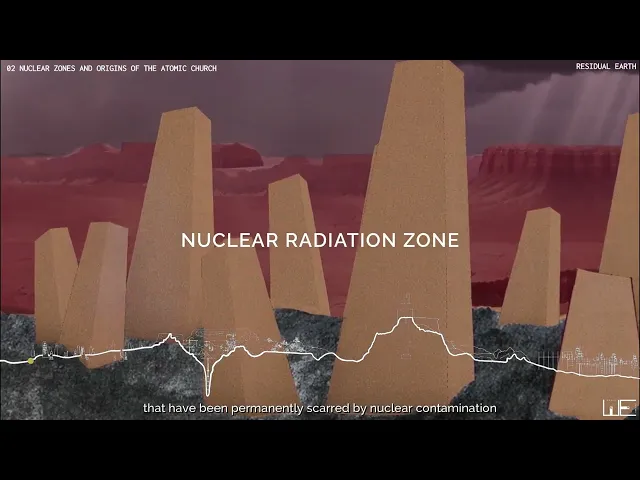
In this world, planetary life reorganises around the management, extraction, and meaning of waste. Abandoned mines, once left to leak toxins, are reoccupied by displaced populations who carve illicit settlements and black‑market mineral economies into poisoned geology. The Earth is split in two: Terravitalis (or the Cleanland), where wealthy nations stabilized their environments, and Terradetritus (or the Wasteland), where the Global South bears the costs of extraction, waste accumulation, and nuclear contamination.
The Wasteland is governed by a quasi-religious institution that calls itself the Atomic Church, which controls energy, movement, and reproduction through new social hierarchies and fears based on blood contamination levels. Entire economies thrive sustained by the scavenging, processing, and trading of waste. This world exposes a deep planetary asymmetry in which the costs of extraction and contamination are unevenly distributed, asking how long a civilisation can sustain itself by offshoring its waste and toxicity onto those with the least power to refuse it.

Terradetritus
WORLD FILM
PHASE 05. INDIVIDUAL PROJECT
VITA-SKIN
Assigned Bodies, Authorized Pleasure
CRITICAL QUESTION
What happens to intimacy when bodies, reproduction, and desire are altered by control and decay?
WHAT IS THE PROJECT?
This product system enables intimacy through institutionally sanctioned, body-adaptable devices that replace direct human contact with mediated sensory experiences. It generates gender-affirming feedback through shifting “intimacy zones,” redefining how the body is known and felt. The system also includes testosterone and estrogen patches that support hormonal regulation and affirmation across genders. Simultaneously, it records bodily responses and usage patterns, positioning intimacy as something tracked, evaluated, and regulated within a controlled framework.
WHY IS THIS PROJECT RELEVANT?
This project remains relevant because intimacy today is increasingly shaped by mediated systems of apps, platforms, and connected devices, where connection is designed, filtered, and controlled rather than purely physical. At the same time, gender-affirming products remain limited, often prioritizing appearance over lived sensory experience. Sexuality continues to be influenced by institutional frameworks, while LGBTQ+ identities are frequently politicized rather than meaningfully supported. This project critically responds to these conditions, revealing how systems that appear to offer affirmation can also regulate bodies, behaviors, and access to intimacy.
THE PROCESS
This project began as an investigation into how intimacy would evolve within the world of Residual Earth. Initially, the focus was on designing general intimacy products for this speculative future. However, as the concepts developed, there was a realisation that the people inhabiting this contaminated environment would not understand intimacy in the same way we do today. Their bodies, relationships, and systems of connection operate through entirely different logics shaped by contamination, surveillance, and controlled interaction.
The project then shifted from simply designing products to constructing intimacy itself within this world. It explored how the governing system,the Atomic Church would introduce and normalize intimacy for its population, and how these systems of pleasure, care, and protection could simultaneously function as tools of surveillance and social control. Through this shift, VITA SKIN emerged as both an intimacy interface and a governing infrastructure for regulating bodies, relationships, and future generations.
Related Projects: Residual Earth


