

Aditi
Kothari
As Above, So Below
Surface Rituals, Subsurface Power
Architecture
Substrate Politics Engine
Residual Earth World
Before this studio, I took many things for granted simply because they felt invisible or normal. The process shifted the way I look at systems and the hidden relationships that shape everyday life. I began to understand how interconnected things are, where even small actions can create consequences over time in ways we often do not notice. The studio also made me think about how systems are never fully stable or controllable, but constantly shifting, transforming, and breaking down. Instead of seeing design only as a way to fix problems, I began to understand discursive design as a way of engaging with uncertainty, questioning existing realities, and confronting the systems and consequences that already exist around us.
STUDIO PROCESS
PHASE 01. MEDIA EXTRACTION
Students extract ≥25 fragments per episode from series like Black Mirror and Silo, documenting each with screenshot, timestamp, annotations, and tags. Fragments reveal emerging systems, governance, temporal rhythms, and interfaces. Analysis clusters fragments into nine operational modes: measures, controls, produces, circulates, excludes, cares, wastes, houses, transforms.

PHASE 02.1 WORLD ENGINE RESEARCH
As these data points accumulated, the wall was reorganized into Six World Engines—competing systemic logics that interpreted the same fragments through different rules and exclusions. Rather than avoiding conflict, this phase utilized the friction between these engines to identify productive tensions across the archive.

PHASE 02.2 PESTLE
To transform these engines from atmospheres into functioning apparatuses, fragments were plotted across a PESTLE matrix (Political, Environmental, Social, Technological, Economic, and Legal). Real-world case studies were mapped onto this same structure, grounding speculation in existing actors and laws. This process forced the articulation of each engine’s systemic performance, making structural gaps and contradictions visible through structured infographics.

PHASE 02.3 INFOGRAPHIC
Substrate Politics
Substrate Politics focused on the ground as a layered political construct shaped by extraction, deposition, and concealment. It examined how minerals, waste, and buried histories reorganized territory and power, making visible landscapes of mining, landfills, and toxic accumulation. At the same time, it revealed how long-term environmental impacts and displaced narratives remained hidden beneath the surface, producing uneven geographies of visibility and control across time.

PHASE 03. MICRONARRATIVES & OPERATIONAL CHAINS
Students generated hybrid worlds through a process of controlled collisions using a "slot-machine" randomizer. This tool forced the PESTLE categories of different engines to overlap, resulting in "Franken-PESTLE" configurations characterized by friction and excess. During this stage, the focus shifted from coherence to the exploration of strange, unstable, and often contradictory world-logics.
The generated hybrid worlds were tested through short narrative sequences that traced the interactions of specific actors and institutions. These scenarios were then visualized through complex collages, translating abstract systemic logic into tangible spatial and social environments.

PHASE 04. THE WORLD STACK
Narrative sequences aggregate into World Stacks: multi-layered frameworks spanning planetary, territorial, institutional, bodily, and representational scales. Working in groups, each team inherits and constructs a shared world and treats layers as interconnected systems that together produce a coherent world logic. Worldbuilding becomes cumulative, stabilizing relationships between infrastructures, governance, and lived experience. Each World Stack functions as a shared framework for subsequent individual projects.
These stacks were visualized into one cohesive image, aimed at designing a visual language for their worlds, and provided a consistent sense of scale and atmosphere for their films.
The call-out cards then forced them to identify the specific narrative anchors, the small details, helping them move away from generic decoration and toward intentional storytelling.

THE WORLD OF
The Residual Earth
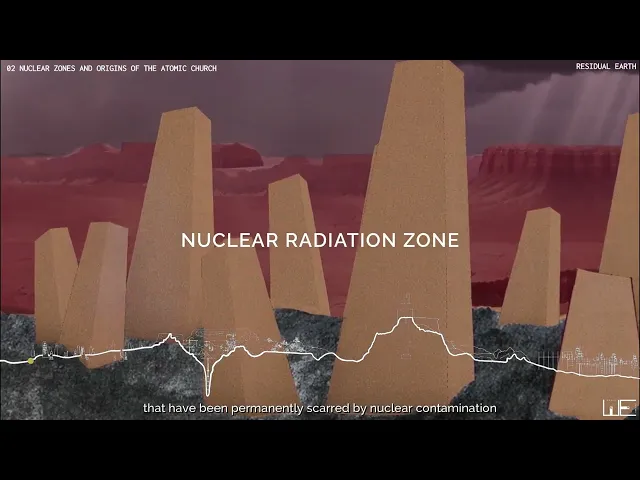
In this world, planetary life reorganises around the management, extraction, and meaning of waste. Abandoned mines, once left to leak toxins, are reoccupied by displaced populations who carve illicit settlements and black‑market mineral economies into poisoned geology. The Earth is split in two: Terravitalis (or the Cleanland), where wealthy nations stabilized their environments, and Terradetritus (or the Wasteland), where the Global South bears the costs of extraction, waste accumulation, and nuclear contamination.
The Wasteland is governed by a quasi-religious institution that calls itself the Atomic Church, which controls energy, movement, and reproduction through new social hierarchies and fears based on blood contamination levels. Entire economies thrive sustained by the scavenging, processing, and trading of waste. This world exposes a deep planetary asymmetry in which the costs of extraction and contamination are unevenly distributed, asking how long a civilisation can sustain itself by offshoring its waste and toxicity onto those with the least power to refuse it.

TERRADETRITUS
WORLD FILM
PHASE 05. INDIVIDUAL PROJECT
As Above, So Below
Surface Rituals, Subsurface Power
CRITICAL QUESTION
What sustains belief and obedience across generations when the systems that govern life are too complex or dangerous to understand, and what infrastructures, labour, and violence must remain hidden for such architectures of faith and power to endure?
WHAT IS THE PROJECT?
Set along a creek in a landscape reshaped by the afterlives of technology, this project imagines an atomic church tasked with preserving knowledge of the nuclear infrastructures buried beneath it across immense timescales. Organised as a dialogue between surface and depth, the underground holds reactors and storage vaults, while the surface operates as a religious terrain of ritual, procession, and hierarchy. The church converts invisible technological systems into durable belief, concealing the infrastructures and power relations that sustain them.
WHY IS THIS PROJECT RELEVANT?
We already live with technologies whose destructive potential and complexity exceed our capacity to fully govern or understand them. Invisible technological, political, and financial systems organise everyday life while remaining opaque to most people. This project mirrors a condition in which opacity itself becomes a tool of power, and fear, uncertainty, and the promise of progress regulate behaviour more effectively than transparency, echoing contemporary systems of control that endure precisely because their operations stay hidden and unquestioned.
THE PROCESS
“Faust, in exchange for worldly power and forbidden knowledge, surrenders his soul to the devil.”
The project emerged through research into nuclear infrastructures, waste storage, technological afterlives, and the idea of the nuclear priesthood, examining relationships between knowledge, power, ambition, and irreversible consequence. It questions how systems of belief might form around energy itself, treating it not as a metaphysical god but as a material force capable of organizing ritual, obedience, labour, and institutional authority. This revealed how systems of control operate through opacity, where invisible networks of energy, maintenance, and risk remain inaccessible to the public.
Investigations into church typologies and spatial hierarchy informed the reading of the creek as a linear and ritualized site condition within a residual landscape shaped by erosion and infrastructural residue. Through sketches and sectional studies, the architecture developed as a dialogue between visible religious landscapes above and buried infrastructural systems below. Drawing from the logic of stepwells and negative verticality, the project organizes descent toward the reactor core beneath the site. Above ground, architecture appears as fragmented markers of ritual and control, while below ground reactors, turbines,and processing systems are organized through secrecy, restricted access, and continuous maintenance.
Related Projects: Residual Earth


