

Ishan
Bhond
DIE(T)GETIC
Recipes from the last ecologies
Design
Synthetic Intelligence Engine
Residual Earth World
STUDIO PROCESS
PHASE 01. MEDIA EXTRACTION
Students extract ≥25 fragments per episode from series like Black Mirror and Silo, documenting each with screenshot, timestamp, annotations, and tags. Fragments reveal emerging systems, governance, temporal rhythms, and interfaces. Analysis clusters fragments into nine operational modes: measures, controls, produces, circulates, excludes, cares, wastes, houses, transforms.

PHASE 02. WORLD ENGINE
Synthetic Intelligence
PHASE 02.1 WORLD ENGINE RESEARCH
As these data points accumulated, the wall was reorganized into Six World Engines—competing systemic logics that interpreted the same fragments through different rules and exclusions. Rather than avoiding conflict, this phase utilized the friction between these engines to identify productive tensions across the archive.

PHASE 02.2 PESTLE
To transform these engines from atmospheres into functioning apparatuses, fragments were plotted across a PESTLE matrix (Political, Environmental, Social, Technological, Economic, and Legal). Real-world case studies were mapped onto this same structure, grounding speculation in existing actors and laws. This process forced the articulation of each engine’s systemic performance, making structural gaps and contradictions visible through structured infographics.

PHASE 02.3 INFOGRAPHIC
Synthetic Intelligence examined worlds governed through continuous data capture, prediction, and algorithmic decision-making. It traced how scoring systems, automated infrastructures, and optimization logics redistributed access to housing, labor, and resources. While these systems appeared efficient and objective, the engine exposed their dependence on biased data and rigid models, often excluding those who could not be quantified, classified, or predicted within its operational frameworks.

PHASE 03. MICRONARRATIVES & OPERATIONAL CHAINS
Students generated hybrid worlds through a process of controlled collisions using a "slot-machine" randomizer. This tool forced the PESTLE categories of different engines to overlap, resulting in "Franken-PESTLE" configurations characterized by friction and excess. During this stage, the focus shifted from coherence to the exploration of strange, unstable, and often contradictory world-logics.
The generated hybrid worlds were tested through short narrative sequences that traced the interactions of specific actors and institutions. These scenarios were then visualized through complex collages, translating abstract systemic logic into tangible spatial and social environments.


PHASE 04. WORLD STACK
The Residual Earth
Narrative sequences aggregate into World Stacks: multi-layered frameworks spanning planetary, territorial, institutional, bodily, and representational scales. Working in groups, each team inherits and constructs a shared world and treats layers as interconnected systems that together produce a coherent world logic. Worldbuilding becomes cumulative, stabilizing relationships between infrastructures, governance, and lived experience. Each World Stack functions as a shared framework for subsequent individual projects.
These stacks were visualized into one cohesive image, aimed at designing a visual language for their worlds, and provided a consistent sense of scale and atmosphere for their films.
The call-out cards then forced them to identify the specific narrative anchors, the small details, helping them move away from generic decoration and toward intentional storytelling.

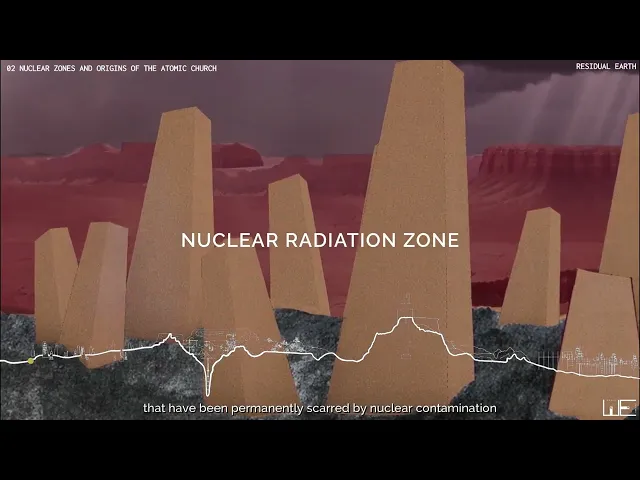
In this world, planetary life reorganises around the management, extraction, and meaning of waste. Abandoned mines, once left to leak toxins, are reoccupied by displaced populations who carve illicit settlements and black‑market mineral economies into poisoned geology. The Earth is split in two: Terravitalis (or the Cleanland), where wealthy nations stabilized their environments, and Terradetritus (or the Wasteland), where the Global South bears the costs of extraction, waste accumulation, and nuclear contamination.
The Wasteland is governed by a quasi-religious institution that calls itself the Atomic Church, which controls energy, movement, and reproduction through new social hierarchies and fears based on blood contamination levels. Entire economies thrive sustained by the scavenging, processing, and trading of waste. This world exposes a deep planetary asymmetry in which the costs of extraction and contamination are unevenly distributed, asking how long a civilisation can sustain itself by offshoring its waste and toxicity onto those with the least power to refuse it.

TERRADETRITUS
WORLD FILM
PHASE 05. INDIVIDUAL PROJECT
DIE(T)GETIC
Recipes from the last ecologies
CRITICAL QUESTION
When conventional agriculture collapses, how do damaged ecologies and unequal infrastructures rewrite what can be eaten, and what does it reveal about the hidden systems and sacrifices already embedded in our present food chains?
WHAT IS THE PROJECT?
DIE(T)GETIC is a collection of speculative food infographics that maps food systems in a post‑agricultural world. It traces how ingredients are sourced from contaminated, subterranean, and marginal ecologies, then processed, cooked, and served through improvised rituals and infrastructures. Each recipe becomes a diagram of labour, risk, and adaptation embedded in the Wasteland’s territories.
WHY IS THIS PROJECT RELEVANT?
This project exposes how deeply food is entangled with environmental damage, class inequality, and infrastructural violence. By turning recipes into critical diagrams, it reveals the hidden systems and sacrifices required to keep eating in compromised worlds. It insists that “future food” is not a sleek solution, but a negotiation with toxicity, scarcity, and power that is already underway today.
THE PROCESS
Die(t)getic began with a world and worked inward toward a plate. The project required building the ecological, political, and infrastructural logic of three transformed territories before a single ingredient could be justified — understanding radiotrophic fungi, insect protein cultivation, algae bioreactor systems, and contamination thresholds was the prerequisite for designing anything. Each infographic was then developed as a food system map: tracing ingredients from source through cultivation, processing, and preparation to the finished dish. The structure was not imposed on the content — it emerged from it. Ingredients that required more processing got more steps. Sources that were contested got flags. Nothing was included for visual interest alone. The result is three infographics — wasteland megacity, mine cities, and coastal region — each formally distinct, each built around the specific material realities of where that food comes from and what it costs to make it edible.
Related Projects: Residual Earth


