

Vimal
Raj
MINE YOUR BUSINESS
Markets of Waste, Trade and Survival in Mine Cities
Architecture
Substrate Politics Engine
Residual Earth World
The studio was an exercise in unlearning; of misconceptions, prejudices, ignorances, and flawed approaches. In my experience, worldbuilding and speculation are too often dismissed as fantastical or indulgently imaginative. But over four months, I was exposed to a very different way of thinking: one strictly grounded in causality and logical follow-throughs. Developing micro-narratives and then expanding them into a full-fledged world was among the most exciting weeks of my design education. The individual project became a testing ground for these new problem-solving tools in our arsenal. My biggest takeaway, and what made this studio worthwhile, are the skills gained in crafting compelling narratives by thinking of the underlying logics of systems that make the world run.
STUDIO PROCESS
PHASE 01. MEDIA EXTRACTION
Students extract ≥25 fragments per episode from series like Black Mirror and Silo, documenting each with screenshot, timestamp, annotations, and tags. Fragments reveal emerging systems, governance, temporal rhythms, and interfaces. Analysis clusters fragments into nine operational modes: measures, controls, produces, circulates, excludes, cares, wastes, houses, transforms.

PHASE 02.1 WORLD ENGINE RESEARCH
As these data points accumulated, the wall was reorganized into Six World Engines—competing systemic logics that interpreted the same fragments through different rules and exclusions. Rather than avoiding conflict, this phase utilized the friction between these engines to identify productive tensions across the archive.

PHASE 02.2 PESTLE
To transform these engines from atmospheres into functioning apparatuses, fragments were plotted across a PESTLE matrix (Political, Environmental, Social, Technological, Economic, and Legal). Real-world case studies were mapped onto this same structure, grounding speculation in existing actors and laws. This process forced the articulation of each engine’s systemic performance, making structural gaps and contradictions visible through structured infographics.

PHASE 02.3 INFOGRAPHIC
Substrate Politics
Substrate Politics focused on the ground as a layered political construct shaped by extraction, deposition, and concealment. It examined how minerals, waste, and buried histories reorganized territory and power, making visible landscapes of mining, landfills, and toxic accumulation. At the same time, it revealed how long-term environmental impacts and displaced narratives remained hidden beneath the surface, producing uneven geographies of visibility and control across time.

PHASE 03. MICRONARRATIVES & OPERATIONAL CHAINS
Students generated hybrid worlds through a process of controlled collisions using a "slot-machine" randomizer. This tool forced the PESTLE categories of different engines to overlap, resulting in "Franken-PESTLE" configurations characterized by friction and excess. During this stage, the focus shifted from coherence to the exploration of strange, unstable, and often contradictory world-logics.
The generated hybrid worlds were tested through short narrative sequences that traced the interactions of specific actors and institutions. These scenarios were then visualized through complex collages, translating abstract systemic logic into tangible spatial and social environments.

PHASE 04. THE WORLD STACK
Narrative sequences aggregate into World Stacks: multi-layered frameworks spanning planetary, territorial, institutional, bodily, and representational scales. Working in groups, each team inherits and constructs a shared world and treats layers as interconnected systems that together produce a coherent world logic. Worldbuilding becomes cumulative, stabilizing relationships between infrastructures, governance, and lived experience. Each World Stack functions as a shared framework for subsequent individual projects.
These stacks were visualized into one cohesive image, aimed at designing a visual language for their worlds, and provided a consistent sense of scale and atmosphere for their films.
The call-out cards then forced them to identify the specific narrative anchors, the small details, helping them move away from generic decoration and toward intentional storytelling.

THE WORLD OF
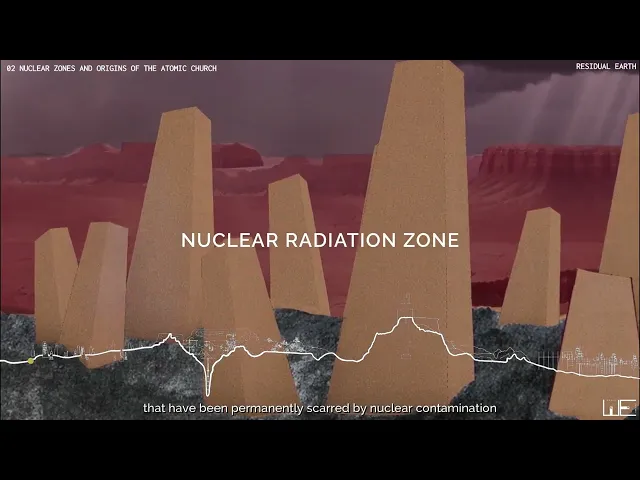
The Residual Earth

TERRADETRITUS
WORLD FILM
PHASE 05. INDIVIDUAL PROJECT
MINE YOUR BUSINESS
Markets of Waste, Trade and Survival in Mine Cities
CRITICAL QUESTION
In a world where cities emerge within exhausted extraction landscapes and survival depends on the circulation, valuation, and repair of waste, how can architecture organize systems of exchange that reveal the relationships between labor, value, control, and collective life?
WHAT IS THE PROJECT?
The project proposes an informal market embedded within the upper rings of a speculative mine city, formed inside exhausted open-pit extraction sites. It serves as shared infrastructure for communities surviving within waste economies; a modular, reconfigurable system where salvaged materials are traded, repaired, dismantled, and auctioned. Built through a dual material framework of the given (standardized processed materials) and the found (salvaged components), the market becomes a flexible architecture for trade, labor, and collective survival.
WHY IS THIS PROJECT RELEVANT?
The project responds to growing conditions of waste urbanism, resource scarcity, and informal labour economies, where discarded materials increasingly sustain systems of survival. It examines how markets function as critical infrastructures of exchange, repair, and redistribution, transforming waste into value and labor into economic agency. By positioning architecture within these informal economies, the project explores how space can organize trade and support collective interdependence in extractive environments shaped by scarcity and unequal power.
THE PROCESS
The project imagines a future where exhausted extraction pits are no longer abandoned landscapes, but become inhabited urban systems, organized vertically through the logic of the mine. The market sits at its center, positioned between surface reclamation yards and residential rings below, and here recovered waste materials move through interconnected systems of barter, repair, and auction, changing form and gaining value at each stage.
Exchange is structured through ReValue Units (RU), a currency tied to material quality, rarity and usability. Every item is weighed, graded, tagged and registered, creating a controlled system of ownership within an informal economy. Mine bosses regulate stall allocations and the flow of goods, embedding hierarchy and power into daily trade. The same material logic of the given and the found that builds housing is reconfigured here into spaces for commerce, repair, and gathering, thus asking what architecture becomes when its purpose is not shelter or monument,but the organization of exchange in a world where waste becomes the primary resource for sustaining life.
Related Projects: Residual Earth


