

Aravind
Ramachandran
THE BIOLOGICAL COMMONS
Where Identity becomes Inventory
Design
Geoengineering Engine
Modular Covenant World
STUDIO PROCESS
PHASE 01. MEDIA EXTRACTION
Students extract ≥25 fragments per episode from series like Black Mirror and Silo, documenting each with screenshot, timestamp, annotations, and tags. Fragments reveal emerging systems, governance, temporal rhythms, and interfaces. Analysis clusters fragments into nine operational modes: measures, controls, produces, circulates, excludes, cares, wastes, houses, transforms.

PHASE 02. WORLD ENGINE
Geoengineering
PHASE 02.1 WORLD ENGINE RESEARCH
As these data points accumulated, the wall was reorganized into Six World Engines—competing systemic logics that interpreted the same fragments through different rules and exclusions. Rather than avoiding conflict, this phase utilized the friction between these engines to identify productive tensions across the archive.

PHASE 02.2 PESTLE
To transform these engines from atmospheres into functioning apparatuses, fragments were plotted across a PESTLE matrix (Political, Environmental, Social, Technological, Economic, and Legal). Real-world case studies were mapped onto this same structure, grounding speculation in existing actors and laws. This process forced the articulation of each engine’s systemic performance, making structural gaps and contradictions visible through structured infographics.

PHASE 02.3 INFOGRAPHIC
Geoengineering approached the climate as a system open to deliberate technological intervention. It examined proposals to regulate temperature, carbon, and atmospheric conditions through large-scale operations such as aerosol injection, carbon capture, and planetary reflectors. While positioned as solutions to the climate crisis, the engine revealed the political and ethical tensions embedded in these interventions, including unequal risks, long-term dependencies, and the redistribution of environmental consequences across regions.

PHASE 03. MICRONARRATIVES & OPERATIONAL CHAINS
Students generated hybrid worlds through a process of controlled collisions using a "slot-machine" randomizer. This tool forced the PESTLE categories of different engines to overlap, resulting in "Franken-PESTLE" configurations characterized by friction and excess. During this stage, the focus shifted from coherence to the exploration of strange, unstable, and often contradictory world-logics.
The generated hybrid worlds were tested through short narrative sequences that traced the interactions of specific actors and institutions. These scenarios were then visualized through complex collages, translating abstract systemic logic into tangible spatial and social environments.


PHASE 04. WORLD STACK
The Modular Convenant
Narrative sequences aggregate into World Stacks: multi-layered frameworks spanning planetary, territorial, institutional, bodily, and representational scales. Working in groups, each team inherits and constructs a shared world and treats layers as interconnected systems that together produce a coherent world logic. Worldbuilding becomes cumulative, stabilizing relationships between infrastructures, governance, and lived experience. Each World Stack functions as a shared framework for subsequent individual projects.
These stacks were visualized into one cohesive image, aimed at designing a visual language for their worlds, and provided a consistent sense of scale and atmosphere for their films.
The call-out cards then forced them to identify the specific narrative anchors, the small details, helping them move away from generic decoration and toward intentional storytelling.

In this world, The Stack is a vertical megastructure where insurance and modularity have hardened into the basic operating conditions of life. Space, bodies, and identities do not precede the building; they are assembled through contractually defined modules, climate bands, and compatibility thresholds. Modularity becomes an ontology rather than a design feature: units, organs, implants, and even memories are slotted, upgraded, or downgraded according to shifting risk profiles.
Within this architecture, nature is no longer a surrounding environment but a catalogue of modular bio-enclaves, calibrated as rentable microclimates and therapeutic ecologies. Citizens are sorted into rigid strata by biological and actuarial criteria, their bodies augmented for survival or optimisation at different heights. Safety solidifies into a tiered privilege rather than a shared condition, and to belong is to remain legible to the Stack’s metrics, compatible with its bands, and continuously adjustable to its evolving calculus of who counts as insurable life.

Residue : Survival as Subscription
WORLD FILM
PHASE 05. INDIVIDUAL PROJECT
THE BIOLOGICAL COMMONS
Where Identity becomes Inventory
CRITICAL QUESTION
In a city where insurance governs space, movement, and biology, what does it mean to have a self that exists beyond what can be insured?
WHAT IS THE PROJECT?
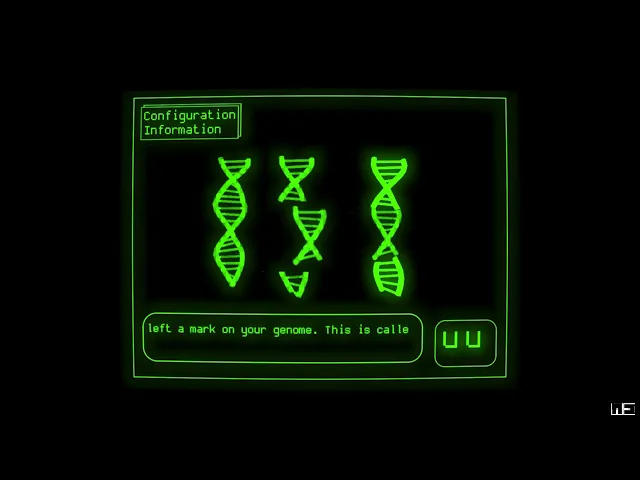
In a world where bodies and spaces are modular, and governed by risk, biological components: organs, tissues and bio-systems circulate through the stack's regulated commons as certified, insurable assets. This project is the interface through which inhabitants of the Stack engage with that commons. A diegetic artifact that functions simultaneously as marketplace and personal dashboard, giving users visibility over their own biological configuration and enabling them to participate in the trade of modules that constitute it.
WHY IS THIS PROJECT RELEVANT?
Contemporary bio-tech and insurance economies already treat bodies as component systems. Biological transplantation operates on the idea that biological material can be transferred between people cleanly. Genetic editing assumes interventions are discrete. Insurance models determine risk by treating individuals as stable units despite biological reality being far messier.
The Stack extrapolates these logics: a world where the fiction of discrete personhood becomes enforceable infrastructure. The project doesn't warn against a future but instead reveals what our current systems already do when they price life, circulate biological material, and decide which bodies count as insurable.
THE PROCESS
The project started with a simple question about identity: what it is, where it comes from, and the different ways it takes form. That question led me to John Locke, and from Locke into thinking about what happens to identity when the assumptions he built on no longer hold.
The Modular Covenant is a world where control reaches down to the cellular level. Bodies are monitored, memories are licensed, and personhood is granted not to a person but to a configuration of certified parts. I wanted to understand what system would actually produce and sustain that condition and what the machinery of it looked like from the inside.
The Biological Commons became my answer to that. The driving question was how a world built on modularity would affect identity. The commons was the system through which the world disaggregates a person into constituent parts, certifies each one individually, circulates them through a shared archive, and in doing so, quietly strips the individual of any claim to themselves as a whole.
Related Projects: Modular Covenant


