

Daksha
Singh
TILED ECOLOGIES
Curating the modular logic of insurable nature
Architecture
Synthetic Intelligence Engine
Modular Covenant World
Coming into this studio, I had little understanding of what speculative design actually was. I chose it because it felt different from conventional architectural studios that primarily focus on design development, technical drawings, and execution skills, which I had already explored in previous semesters. This studio introduced me to a completely new way of thinking about architecture. It was engaging, thought-provoking, and genuinely enjoyable. Through narratives, case studies, and layered explorations of political and environmental scenarios, I learned to critically speculate on possible futures and solutions. I also got the opportunity to work with several new software tools and mediums. The interdisciplinary nature of the studio allowed me to interact with peers from diverse backgrounds and learn from their perspectives. The faculty were extremely knowledgeable, supportive, and understanding throughout the process, constantly encouraging exploration and experimentation. Overall, the studio was an enriching experience that expanded my skills and introduced me to new speculative thinking horizons.
STUDIO PROCESS
PHASE 01. MEDIA EXTRACTION
Students extract ≥25 fragments per episode from series like Black Mirror and Silo, documenting each with screenshot, timestamp, annotations, and tags. Fragments reveal emerging systems, governance, temporal rhythms, and interfaces. Analysis clusters fragments into nine operational modes: measures, controls, produces, circulates, excludes, cares, wastes, houses, transforms.

PHASE 02.1 WORLD ENGINE RESEARCH
As these data points accumulated, the wall was reorganized into Six World Engines—competing systemic logics that interpreted the same fragments through different rules and exclusions. Rather than avoiding conflict, this phase utilized the friction between these engines to identify productive tensions across the archive.

PHASE 02.2 PESTLE
To transform these engines from atmospheres into functioning apparatuses, fragments were plotted across a PESTLE matrix (Political, Environmental, Social, Technological, Economic, and Legal). Real-world case studies were mapped onto this same structure, grounding speculation in existing actors and laws. This process forced the articulation of each engine’s systemic performance, making structural gaps and contradictions visible through structured infographics.

PHASE 02.3 INFOGRAPHIC
Synthetic Intelligence
Synthetic Intelligence examined worlds governed through continuous data capture, prediction, and algorithmic decision-making. It traced how scoring systems, automated infrastructures, and optimization logics redistributed access to housing, labor, and resources. While these systems appeared efficient and objective, the engine exposed their dependence on biased data and rigid models, often excluding those who could not be quantified, classified, or predicted within its operational frameworks.

PHASE 03. MICRONARRATIVES & OPERATIONAL CHAINS
Students generated hybrid worlds through a process of controlled collisions using a "slot-machine" randomizer. This tool forced the PESTLE categories of different engines to overlap, resulting in "Franken-PESTLE" configurations characterized by friction and excess. During this stage, the focus shifted from coherence to the exploration of strange, unstable, and often contradictory world-logics.
The generated hybrid worlds were tested through short narrative sequences that traced the interactions of specific actors and institutions. These scenarios were then visualized through complex collages, translating abstract systemic logic into tangible spatial and social environments.

PHASE 04. THE WORLD STACK
Narrative sequences aggregate into World Stacks: multi-layered frameworks spanning planetary, territorial, institutional, bodily, and representational scales. Working in groups, each team inherits and constructs a shared world and treats layers as interconnected systems that together produce a coherent world logic. Worldbuilding becomes cumulative, stabilizing relationships between infrastructures, governance, and lived experience. Each World Stack functions as a shared framework for subsequent individual projects.
These stacks were visualized into one cohesive image, aimed at designing a visual language for their worlds, and provided a consistent sense of scale and atmosphere for their films.
The call-out cards then forced them to identify the specific narrative anchors, the small details, helping them move away from generic decoration and toward intentional storytelling.

THE WORLD OF
The Modular Convenant
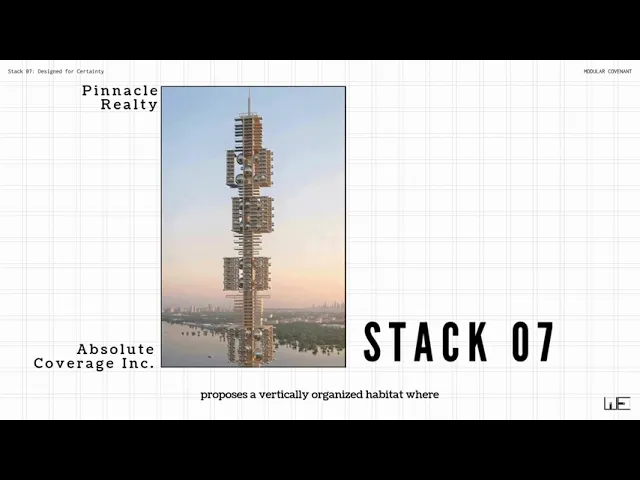
In this world, The Stack is a vertical megastructure where insurance and modularity have hardened into the basic operating conditions of life. Space, bodies, and identities do not precede the building; they are assembled through contractually defined modules, climate bands, and compatibility thresholds. Modularity becomes an ontology rather than a design feature: units, organs, implants, and even memories are slotted, upgraded, or downgraded according to shifting risk profiles.
Within this architecture, nature is no longer a surrounding environment but a catalogue of modular bio-enclaves, calibrated as rentable microclimates and therapeutic ecologies. Citizens are sorted into rigid strata by biological and actuarial criteria, their bodies augmented for survival or optimisation at different heights. Safety solidifies into a tiered privilege rather than a shared condition, and to belong is to remain legible to the Stack’s metrics, compatible with its bands, and continuously adjustable to its evolving calculus of who counts as insurable life.

Tiled Ecologies
WORLD FILM
PHASE 05. INDIVIDUAL PROJECT
TILED ECOLOGIES
Curating the modular logic of insurable nature
CRITICAL QUESTION
How does insurance, as a technology of risk management, restructure nature into compartmentalised, failure-resistant units within the Stack, and in doing so, redefine the relationship between ecology, ownership, and control?
WHAT IS THE PROJECT?
Tiled Ecologies is a modular system where nature is reconfigured as a curated architectural product within the Stack. It operates through preassembled ecological tiles—desert, rainforest, grassland, and tundra—each containing complete environmental and infrastructural systems. Users assemble these tiles and select from controlled ecological libraries to create private bio-enclaves. As ownership expands, these systems scale into larger enclosed environments, making nature modular, insurable, and governed through access, control, and risk management.
WHY IS THIS PROJECT RELEVANT?
As ecological systems grow unstable and inaccessible, nature is increasingly mediated through technology, ownership, and control. This project examines how insurance logics transform ecology into contained, failure-resistant units, shifting it from a shared condition to a regulated resource. It highlights how access to stable environments becomes unequal, raising questions about who gets to experience “nature” in a future where it can no longer exist freely.
THE PROCESS
The Tiled Ecologies project emerged from investigating how nature might exist within highly compartmentalized vertical cities shaped by environmental instability, risk management, and infrastructural dependence. As ecological collapse intensified outside the Stack, naturally occurring landscapes became increasingly difficult to preserve, leading to the development of controlled ecological systems designed around modularity, maintenance, and insurance-based regulation.
The project evolved through the idea of constructing ecosystems as interchangeable tile assemblies capable of scaling across different dome sizes and environmental conditions. Each tile integrates vegetation, irrigation, drainage, and atmospheric systems, allowing ecologies to be curated, replaced, or isolated without disrupting the larger enclave. Insurance classification became central to the logic of the system, determining ecological access, maintenance priority, and environmental quality within the Stack.
Rather than treating nature as an uncontrolled landscape, Tiled Ecologies reimagines it as a regulated infrastructural product — calibrated, monitored, and distributed according to risk, privilege, and urban necessity.
Related Projects: Modular Covenant


