

Yadnyee
Palshikar
Museum of Real Ecology
The Risks We Left Behind
Architecture
Geoengineering Engine
Licensed Biomes World
The primary takeaway is the realization that architecture is a powerful discursive tool. It is capable of more than just building—it can audit reality and shape futures. By framing the environment as Biological Debt, this project demonstrated how speculative, plausible futures expose the "market-based conservation" and financialization of nature occurring today.
I learned to use project identity and conceptual detailing not as mere design, but as a medium to provoke critical conversations about corporate stewardship and biological inequality. The project proves that architecture can successfully challenge current trajectories by rendering our "commodified" future visible and debatable.
STUDIO PROCESS
PHASE 01. MEDIA EXTRACTION
Students extract ≥25 fragments per episode from series like Black Mirror and Silo, documenting each with screenshot, timestamp, annotations, and tags. Fragments reveal emerging systems, governance, temporal rhythms, and interfaces. Analysis clusters fragments into nine operational modes: measures, controls, produces, circulates, excludes, cares, wastes, houses, transforms.

PHASE 02.1 WORLD ENGINE RESEARCH
As these data points accumulated, the wall was reorganized into Six World Engines—competing systemic logics that interpreted the same fragments through different rules and exclusions. Rather than avoiding conflict, this phase utilized the friction between these engines to identify productive tensions across the archive.

PHASE 02.2 PESTLE
To transform these engines from atmospheres into functioning apparatuses, fragments were plotted across a PESTLE matrix (Political, Environmental, Social, Technological, Economic, and Legal). Real-world case studies were mapped onto this same structure, grounding speculation in existing actors and laws. This process forced the articulation of each engine’s systemic performance, making structural gaps and contradictions visible through structured infographics.

PHASE 02.3 INFOGRAPHIC
Geoengineering
Geoengineering approached the climate as a system open to deliberate technological intervention. It examined proposals to regulate temperature, carbon, and atmospheric conditions through large-scale operations such as aerosol injection, carbon capture, and planetary reflectors. While positioned as solutions to the climate crisis, the engine revealed the political and ethical tensions embedded in these interventions, including unequal risks, long-term dependencies, and the redistribution of environmental consequences across regions.

PHASE 03. MICRONARRATIVES & OPERATIONAL CHAINS
Students generated hybrid worlds through a process of controlled collisions using a "slot-machine" randomizer. This tool forced the PESTLE categories of different engines to overlap, resulting in "Franken-PESTLE" configurations characterized by friction and excess. During this stage, the focus shifted from coherence to the exploration of strange, unstable, and often contradictory world-logics.
The generated hybrid worlds were tested through short narrative sequences that traced the interactions of specific actors and institutions. These scenarios were then visualized through complex collages, translating abstract systemic logic into tangible spatial and social environments.

PHASE 04. THE WORLD STACK
Narrative sequences aggregate into World Stacks: multi-layered frameworks spanning planetary, territorial, institutional, bodily, and representational scales. Working in groups, each team inherits and constructs a shared world and treats layers as interconnected systems that together produce a coherent world logic. Worldbuilding becomes cumulative, stabilizing relationships between infrastructures, governance, and lived experience. Each World Stack functions as a shared framework for subsequent individual projects.
These stacks were visualized into one cohesive image, aimed at designing a visual language for their worlds, and provided a consistent sense of scale and atmosphere for their films.
The call-out cards then forced them to identify the specific narrative anchors, the small details, helping them move away from generic decoration and toward intentional storytelling.

THE WORLD OF
The Licensed Biomes

Licensed Biomes
WORLD FILM
PHASE 05. INDIVIDUAL PROJECT
Museum of Real Ecology
The Risks We Left Behind
CRITICAL QUESTION
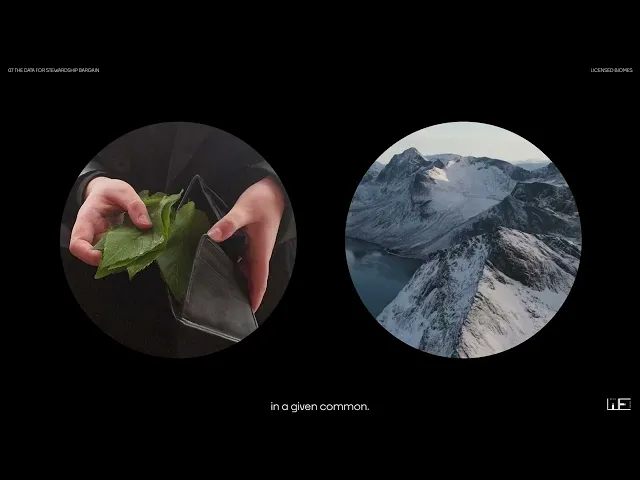
In a world where the “slow and failing” wild has been safely contained, how does corporate stewardship of nature reshape cities, monuments, and daily life—and how are these experiences staged to sell a perfected, commodified, optimized biosphere?
WHAT IS THE PROJECT?
This museum OF REAL ECOLOGY IN GEEC PARK is a sensory "audit" of biological failure. The project is a sensory "audit" of biological failure housed within a high-security containment vault. Visitors undergo a curated experiential journey; The Descent, The Encounter and The Escape designed to liquidate their romantic attachment to the "Real": It makes the "impure" so unbearable that visitors view a GEEC Subscription as a necessary escape into safety.
WHY IS THIS PROJECT RELEVANT?
This question exposes our current shift toward market-based conservation. As we price nature into carbon credits and corporate “offsets,” we risk a future where survival is a subscription. It warns that by commodifying the environment, we turn the basic right to a healthy planet into a private luxury.
THE PROCESS
This project began with the phrase “to look down upon,” reflecting society’s dismissal of emergent nature and ecological adaptation. The concept evolved into a spatial ascent from the museum’s underground past toward a controlled future above. The journey critiques how contemporary museums increasingly construct persuasive narratives, guiding visitors toward ideological and commercial acceptance, culminating in the promotion of “Real Ecology” subscriptions as manufactured environmental salvation.
Related Projects: Licensed Biomes


