

Dhruv
Tokas
TERMINAL GRASP
The GEEC HQ
Architecture
Anthropo-Sentience Engine
Licensed Biomes World
World-Making, was a term coined by the American philosopher Nelson Goodman. He states that worldmaking is the active process of constructing, creating, and organizing the "worlds" we inhabit through symbolic systems such as language, art, science, and cognition.
Before I got selected to this studio, I had a very different perspective about these symbolic systems. But as I graduated throughout the semester, while being exposed to so much data, references and resources, the cognitive overload has really helped understanding the world we inhabit today. There are systems involved that we are never aware of, there are forces playing at all times and a machine that constantly changes.
This also comes down to design and how we perceive a space or an object, understanding what is subjective and what is objective as well. It is hard to explain everything learned in this studio through words, but there is a lot of falling and standing and running throughout.
This all boils down to the new way of thinking, critical thinking. Speculative design has really changed the way to think critically about everything. Let it be about design or the world itself. It has opened a new path that I never wish to leave.
STUDIO PROCESS
PHASE 01. MEDIA EXTRACTION
Students extract ≥25 fragments per episode from series like Black Mirror and Silo, documenting each with screenshot, timestamp, annotations, and tags. Fragments reveal emerging systems, governance, temporal rhythms, and interfaces. Analysis clusters fragments into nine operational modes: measures, controls, produces, circulates, excludes, cares, wastes, houses, transforms.

PHASE 02.1 WORLD ENGINE RESEARCH
As these data points accumulated, the wall was reorganized into Six World Engines—competing systemic logics that interpreted the same fragments through different rules and exclusions. Rather than avoiding conflict, this phase utilized the friction between these engines to identify productive tensions across the archive.

PHASE 02.2 PESTLE
To transform these engines from atmospheres into functioning apparatuses, fragments were plotted across a PESTLE matrix (Political, Environmental, Social, Technological, Economic, and Legal). Real-world case studies were mapped onto this same structure, grounding speculation in existing actors and laws. This process forced the articulation of each engine’s systemic performance, making structural gaps and contradictions visible through structured infographics.

PHASE 02.3 INFOGRAPHIC
Anthropo-Sentience
Anthropo-Sentience Regimes explored how subjects were produced, disciplined, and recognized within different systems of power. It examined how architecture, law, and culture defined who or what counted as a legitimate entity, extending personhood across humans, non-humans, and synthetic beings. The engine highlighted processes of inclusion and exclusion, revealing how certain bodies and intelligences were validated while others remained unrecognized or marginalized within dominant frameworks.

PHASE 03. MICRONARRATIVES & OPERATIONAL CHAINS
Students generated hybrid worlds through a process of controlled collisions using a "slot-machine" randomizer. This tool forced the PESTLE categories of different engines to overlap, resulting in "Franken-PESTLE" configurations characterized by friction and excess. During this stage, the focus shifted from coherence to the exploration of strange, unstable, and often contradictory world-logics.
The generated hybrid worlds were tested through short narrative sequences that traced the interactions of specific actors and institutions. These scenarios were then visualized through complex collages, translating abstract systemic logic into tangible spatial and social environments.

PHASE 04. THE WORLD STACK
Narrative sequences aggregate into World Stacks: multi-layered frameworks spanning planetary, territorial, institutional, bodily, and representational scales. Working in groups, each team inherits and constructs a shared world and treats layers as interconnected systems that together produce a coherent world logic. Worldbuilding becomes cumulative, stabilizing relationships between infrastructures, governance, and lived experience. Each World Stack functions as a shared framework for subsequent individual projects.
These stacks were visualized into one cohesive image, aimed at designing a visual language for their worlds, and provided a consistent sense of scale and atmosphere for their films.
The call-out cards then forced them to identify the specific narrative anchors, the small details, helping them move away from generic decoration and toward intentional storytelling.

THE WORLD OF
The Licensed Biomes
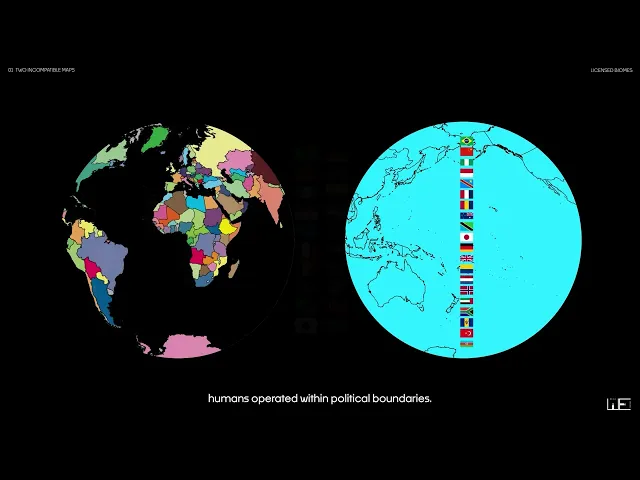
Licensed Biomes imagines Earth governed like a vast conservatory of potted worlds, each ecosystem treated as a managed container on a planetary shelf. As overlapping geoengineering experiments erode trust between states, countries create GEEC, a procedural referee that manages “Planetary Commons” through thresholds and dashboards but depends entirely on external data and operators.
Enviro‑corps step in as technical stewards, installing dense sensing systems, then pivoting from restoration to genetic optimization, turning environmental DNA into patents and proprietary organisms. The planet stratifies into Licensed Biomes—maintenance, production, service, drift, and blind zones—each with distinct protocols and risks. Human genomes remain unowned, yet life is mediated through licensed food webs and microbiomes, making people users rather than owners of the infrastructures that sustain them.

Licensed Biomes
WORLD FILM
PHASE 05. INDIVIDUAL PROJECT
TERMINAL GRASP
The GEEC HQ
CRITICAL QUESTION
In a world where GEEC claims to have “saved” the planet through total management, how does architecture embody sanctuary, control, and stewardship—or the moment when nature is finally immobilized and entombed?
WHAT IS THE PROJECT?
Terminal Grasp is a speculative headquarters for GEEC: five colossal concrete blade‑walls clenching a hollowed rock like a human hand gripping the planet. It stages the institution’s promise of protection and management as a permanent, architectural hold over nature—somewhere between sanctuary, instrument of control, and planetary tomb.
WHY IS THIS PROJECT RELEVANT?
It translates our current drive to model, optimize, and “manage” nature—through climate dashboards, offsets, and geo‑engineering—into a stark spatial image. For today’s audience, it exposes how efforts to save the planet can slip into fantasies of total control, asking whether our desire for stability risks suffocating the very wildness we depend on.
THE PROCESS
The Project started off with the idea of a sanctum that controls nature through monitoring, and the idea of a building that hovers over a forest came into existence. It was soon realized that to show dominance over nature a simple ring like building balancing over stilts will be too fragile. To show that nature is now in total control, the massive walls (man-made) and a rock (natural) in between them were conceptualized. The spaces inside the building are directly carved out of the rock. Created using negative volumes of the required spaces. Each space critically uses openings, light punctured and volume to define the typologies of the spaces
Related Projects: Licensed Biomes


