

Rachana
Vatyani
ALYNE
Wellness For The Accountable Body.
Design
Anthropo-Sentience Engine
Conduct Ledger World
STUDIO PROCESS
PHASE 01. MEDIA EXTRACTION
Students extract ≥25 fragments per episode from series like Black Mirror and Silo, documenting each with screenshot, timestamp, annotations, and tags. Fragments reveal emerging systems, governance, temporal rhythms, and interfaces. Analysis clusters fragments into nine operational modes: measures, controls, produces, circulates, excludes, cares, wastes, houses, transforms.

PHASE 02. WORLD ENGINE
Anthropo-Sentience
PHASE 02.1 WORLD ENGINE RESEARCH
As these data points accumulated, the wall was reorganized into Six World Engines—competing systemic logics that interpreted the same fragments through different rules and exclusions. Rather than avoiding conflict, this phase utilized the friction between these engines to identify productive tensions across the archive.

PHASE 02.2 PESTLE
To transform these engines from atmospheres into functioning apparatuses, fragments were plotted across a PESTLE matrix (Political, Environmental, Social, Technological, Economic, and Legal). Real-world case studies were mapped onto this same structure, grounding speculation in existing actors and laws. This process forced the articulation of each engine’s systemic performance, making structural gaps and contradictions visible through structured infographics.

PHASE 02.3 INFOGRAPHIC
Anthropo-Sentience Regimes explored how subjects were produced, disciplined, and recognized within different systems of power. It examined how architecture, law, and culture defined who or what counted as a legitimate entity, extending personhood across humans, non-humans, and synthetic beings. The engine highlighted processes of inclusion and exclusion, revealing how certain bodies and intelligences were validated while others remained unrecognized or marginalized within dominant frameworks.

PHASE 03. MICRONARRATIVES & OPERATIONAL CHAINS
Students generated hybrid worlds through a process of controlled collisions using a "slot-machine" randomizer. This tool forced the PESTLE categories of different engines to overlap, resulting in "Franken-PESTLE" configurations characterized by friction and excess. During this stage, the focus shifted from coherence to the exploration of strange, unstable, and often contradictory world-logics.
The generated hybrid worlds were tested through short narrative sequences that traced the interactions of specific actors and institutions. These scenarios were then visualized through complex collages, translating abstract systemic logic into tangible spatial and social environments.


PHASE 04. WORLD STACK
The Conduct Ledger
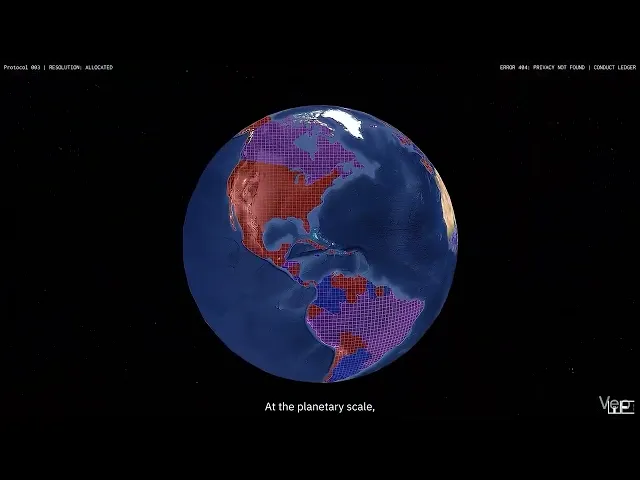
Narrative sequences aggregate into World Stacks: multi-layered frameworks spanning planetary, territorial, institutional, bodily, and representational scales. Working in groups, each team inherits and constructs a shared world and treats layers as interconnected systems that together produce a coherent world logic. Worldbuilding becomes cumulative, stabilizing relationships between infrastructures, governance, and lived experience. Each World Stack functions as a shared framework for subsequent individual projects.
These stacks were visualized into one cohesive image, aimed at designing a visual language for their worlds, and provided a consistent sense of scale and atmosphere for their films.
The call-out cards then forced them to identify the specific narrative anchors, the small details, helping them move away from generic decoration and toward intentional storytelling.

The Conduct Ledger world extends panoptic logic into a fully ambient, data‑driven environment, where visibility is no longer organised around a single watching centre but diffused across platforms, sensors, and interfaces. Surveillance operates not as an episodic act of observation but as a continuous infrastructural condition in which subjects are rendered as streams of data rather than juridical individuals. Governance begins with the calibration of conduct: personality traits, risk profiles, and resource use are folded into a single ledger that allocates opportunity, mobility, and exposure, translating rights into scores and probabilities.
Everyday spaces become programmable environments in which layouts, interfaces, and services are iteratively adjusted in response to behavioural metrics, nudging adjustment while remaining legible as convenience, optimisation, or care. Under cascading crises and climate volatility, this regime presents ubiquitous monitoring as a rational response to complexity, even as it redefines security as maximal transparency. The question it poses is not simply whether privacy has been eroded, but whether autonomy remains thinkable when anticipation, prediction, and pre‑emption become the primary techniques of rule.

Error 404: Privacy Not Found.
WORLD FILM
PHASE 05. INDIVIDUAL PROJECT
ALYNE
Wellness For The Accountable Body.
CRITICAL QUESTION
In a world where carbon conduct defines moral worth, how does the wellness industry transform ecological guilt into consumable self-correction?
WHAT IS THE PROJECT?
ALYNE is a satirical speculative design brand set in the Conduct Ledger, a near-future system where carbon compliance dictates access to housing, healthcare, and jobs. ALYNE sells wellness products as tools to manage and improve a citizen’s Carbon Score, blending sustainability and holistic wellness. The brand’s philosophy is rooted in the belief that the market will provide people with the tools to fulfill their civic duty through consumption.ALYNE masks its satire with sincerity. Its critique emerges from the tension between seductive marketing and the fine print—a dynamic already present in the wellness industry.
—CLICK TO OPEN PROJECT—
WHY IS THIS PROJECT RELEVANT?
When consuming less becomes a civic duty, the market rushes to offer tools for compliance; ALYNE follows this logic to its extreme. Wellness brands already profit from human unease, commodifying stress, aging, and sleep; ecological guilt is simply the newest anxiety to be packaged and sold. With carbon-tracking apps and behavioral data everywhere, the future is already here. ALYNE exposes and sells back the anxieties that the system has already identified.
THE PROCESS
The project started with a question about how ecological guilt gets converted into consumer behaviour, and whether the wellness industry, which has always operated by naming an anxiety and selling the correction, would follow the same logic as carbon responsibility became scored and surveilled.
World-building came first, then the brand, then the products. Ingredients were selected to reflect how far the wellness industry can stretch plausibility in pursuit of profit, not so absurd that they read as joke, but just credible enough that the discomfort arrives slowly. Form followed from the ingredient rather than preceding it.
The process started with the cuboid as a neutral container, and the ingredient's own cross-section, growth structure, or anatomical profile was then subtracted from its interior to create the void. Modelling was done in Rhino and Shapr3D, rendering in Vizcom and Google Flow, and finishing work across Photoshop, InDesign, and DaVinci Resolve.
The visual language was kept dark and moody- black, deep green, and cream, to reflect the project's grounding in carbon culture and green consumerism. Packaging materials were selected to match: Vivomer, Sylvicta paper, and mycelium, chosen for their biodegradability and their legibility as markers of ecological seriousness.
Related Projects: Conduct Ledger